Friendship

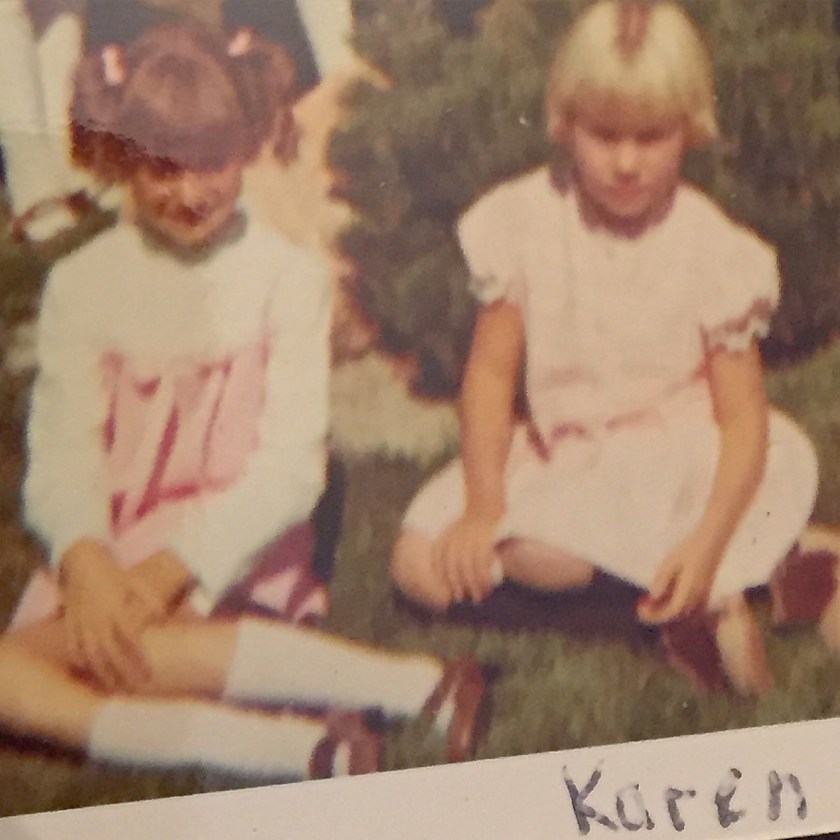
Every year when May 10th rolls around I remember my childhood friend, Karen, and ponder old memories. I often wonder how she’s doing now.

Karen was one year younger than me and was my first friend outside my sisters. We played in each other’s homes and backyards. We walked to and from school together accompanied by our older sisters. We went to the same church, sang in the same choir, and participated in the same Girl Scout Troop.

But we were very different people. She was obsessed with animals and I was fascinated by people, particularly historical and literary figures. We developed a system of playing with one another that accommodated our differences. When we played at her house, we pretended that we were animal families, such as puppies, or kittens.

And we really had to get into the role. Once we even tried out her dog’s kibble in order to be totally in character. She was much better at getting into animal personification. I faked it. I even faked eating the kibble. I just couldn’t stomach the idea of eating dog food.

When we played at my house, we became characters from my books. We laid on our backs and pretended to walk in the upside down house of Mrs Piggle-Wiggle, went out on super blustery days to pretend to get blown from Kansas to Oz, and once we hand-sewed aprons and bonnets in order to go to my backyard and pick cotton wood seeds off the lawn, pretending to be slaves picking cotton on plantations.

I think that last game is what threw her over the edge. She didn’t like play to be work. She preferred lying on lawn chairs or curled up by her toy kitchen sink like her own pet dog did. But I made her work.

One day, not long after the two-day cotton picking affair, I went to her door to see if she could play. Her mother directed me to the field across from our houses. She told me that my friend was outside playing. I wandered over to the field and found her playing with the new girl in the neighborhood. Traci was obsessed with horses and they were pretending to be wild mustangs out on the range. Sigh. Karen had found her soulmate. To be fair, they invited me to play, but after a few minutes of neighing and pawing at the dirt, I made my excuses and my escape.

The next day, they were at it again. Once again I tried my best to muster enthusiasm for my role, but personally I preferred to ride the actual animal out at my Dad’s than to romp through the field pretending to be one. So again I made my way home.

This continued for some time until I noticed that they were starting to share looks when I approached to play. One day I found them out on the back patio of Traci’s house. It wasn’t hard to see them from my own back yard. Only a chain link fence separated our yards. They were eating popsicles and reading magazines. When I came over to say, “hey,” both of their eyes narrowed simultaneously. I sensed they did not want the intrusion of my company. It was plain that my friend had moved on to another.

Similarity is one of the leading characteristics that draws individuals together. Common interests are the glue that holds friendships together. I recognized even then that Karen and I had a loosely knit friendship based more on the convenience of being neighbors, and the only available companions of the right age and sex. Dissimilarity is one of the leading causes of disruption or disconnection in children’s friendships.

But that wasn’t the only reason our friendship met its demise. Karen had found a newer, shinier model who had the added coolness of getting the two of them permission to play in the field across the street from our houses. I was displaced. Displacement can be especially painful, as it compounds the injury of rejection with the insult of being replaced.

I never thought of seeking comfort from my mother. She would simply have told me to find someone else to play with. Friendships matter to children and parents shouldn’t minimize the loss.

If your child is open to discussing the demise of the friendship, listen to them. It may lead to their developing better relationship skills.

Loss is an inevitable part of children’s friendships. If a friendship does not end because of dissimilarity or displacement, it may come about due to distance, when a friend moves away. Regardless of how it happens, it is natural for a child to mourn the loss. You can be there to encourage them to try again.

The Art of Mothering

I was in church this morning when the child in the pew in front of me, a little boy who is just over a year old, began fussing.

Loudly.

We’ve all been there. Our little one really doesn’t want to be in church anymore and begins letting us know in ever louder and more distressed tones.

Often, we hustle our infants out of church. But not only does whichever parent has to leave with the fussing baby miss out on what they came to church for that morning, but they are also teaching the child a lesson.

The child has learned that when church is boring there is sweet release in the freedom to run around in the church’s crying room, entry hall, or basement. So next week, the child may start crying sooner, and keep it up longer, certain that in the end they’ll win out.

But what else can a parent do? I’m sure we’ve also all been in the shoes of the helpless bystander listening to a child’s wails.

Suffering parishioners choose from a variety of stances:

  • Some look askance at the parents who would continue to stay in church while their child is being disruptive.
  • Some look around sheepishly, knowing it was once their own child behaving like this.
  • Some smile sympathetically at Mom.
  • Some look sorrowfully at the child.
  • Some wink at Dad, as if he’s somehow along for the roller coaster ride of parenting, not of his own accord but as some kind of adjunct to the real parent.
  • Some mutter, “Why don’t they take that kid out?” or “That kid needs a spanking.”

Few identify with Mom, letting her know that they understand: sometimes there are days like this.

Even on Mother’s Day.

Over the years I’ve developed a method of joining with fledgling mothers as they are testing the winds of parenting. In fact, I spoke to this mom in church just a couple of weeks back.

She told me that she is tired of missing parts of Mass because her little one doesn’t want to stay in place. She wants her child to learn to sit through an uncomfortable hour, and she knows she is rewarding him with escape trips. But if he keeps it up long enough, she just doesn’t know what else to do.

She didn’t ask for advice and I didn’t offer any. I simply let her know it is hard, and she’s a trooper to hang in there. I told her I’d raised four kids of my own, been a therapist for 29 years, and taught religious education and substitute taught for a few years.

If she wants my advice in a few weeks after she’s come to trust I’m not judging her, I’ll let her know how I’d handle her little one.

At this point, he’s “winning”.

She’s situated herself in a common power struggle we mothers have faced with our offspring since time immemorial. Case in point: after struggling with him for some 30 minutes, she took him out today after communion. In doing so, she taught him that if he keeps up his fussing, he will get the reward of release.

But what could she have done differently? It seemed as if the whole congregation was sending the vibe that they were tired of his noise.

She needs to look at her goal. What does she want to encourage and reinforce? I’m sure she doesn’t want to reinforce his tantrum. But when her power struggle ended with her taking him out, that is what she ultimately reinforced.

Church isn’t the only venue where we face these kinds of struggles with our children. There are trips to the grocery store, library, and places where we have to stand in line. Maybe we want to go to the movies, concerts, or formal ceremonies. Our child decides they don’t want to be there and so they use their voice to let us know that they want to leave–loudly if necessary.

What if a mother instead focused on what would entice her child to want to stay? Why do we go to church? Is it for the companionship, belonging to a community? How does a mother incorporate her ultimate goal into her plan for success?

  1. First, she must decide what her primary goal is, and define it in concrete terms.
  2. Second, she needs to think about steps she can take to reinforce behavior that moves toward that goal. Yes, children do respond to behavioral conditioning.
  3. Third, she needs to let the child know that she recognizes that he doesn’t want to be there. Children need to be heard and know that their parent understands what they want even if they don’t get to have what they want.

Especially if they can’t have what they want.

I believe that a parent can create a plan for success based upon anticipating what their child wants and needs, and building those factors into their preparation for going places. No other parent can give a specific prescription for every mother’s situation. There are no one-size-fits-all, cookie-cutter methods.

That’s why mothering is as much an art as a science.